TVS Diodes 101 A Guide To Choose The Right Circuit Protection
Electrical surges, or transient overvoltage, can cause irreversible damage to sensitive electronic components and malfunctioning equipment.
TVS Diodes 101 A Guide To Choose The Right Circuit Protection
Electrical surges, or transient overvoltage, can cause irreversible damage to sensitive electronic components and malfunctioning equipment.
Adding effective surge protection techniques to electronic systems will significantly enhance electronic products' reliability, longevity, and overall performance. This article explores how Transient Voltage Suppression (TVS) diodes shield electrical circuits from surge, Electrostatic Discharge (ESD), and overvoltage.
A Transient Voltage Suppressor (TVS) is an avalanche diode designed to clamp overvoltage and dissipate high transient power surges. It absorbs excess energy when the induced voltage exceeds its avalanche breakdown voltage and then automatically resets after the overvoltage condition passes.
The TVS diode is a p-n semiconductor junction that becomes conductive during a transient voltage spike. Under normal conditions, it has high impedance and minimal leakage current, effectively acting like an open circuit. When the voltage exceeds its threshold, the avalanche effect in the semiconductor activates, causing the p-n junction to conduct and create a low-impedance path that diverts excessive current away from the protected device.
TVS diodes respond extremely quickly ( in picoseconds), making them effective at diverting intense ESD pulses, even those with fast rise times. Compared to Metal-Oxide Varistors (MOVs), TVS diodes offer several advantages, such as the absence of aging effects, ensuring stability and reliability over time. They are more robust and of higher quality than Zener diodes, rated for low DC and not specified for handling surges.
Once the surge subsides, the diode resets to its high-impedance state, ready to counter the next transient. TVS diodes are available in unidirectional and bidirectional types and are suitable for both DC and AC applications. They are widely used in industrial, consumer, and medical electronics for their reliable, high-speed protection.
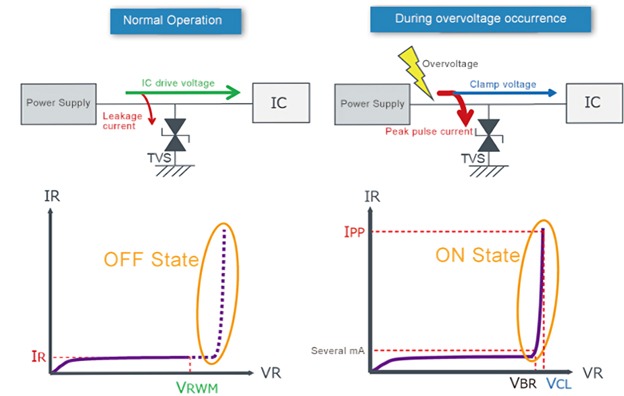
Figure 1: Working principle of TVS diodes (Source)
To ensure reliable protection, TVS diodes must be sized appropriately to handle expected transient pulses without failing while effectively clamping surge voltages without disrupting normal line voltage. Key specifications and electrical characteristics to consider when selecting a TVS diode include –
VRM (Maximum standoff voltage or peak reverse voltage): The maximum continuous voltage a TVS diode can handle without activating its protective response, which is known as the peak reverse voltage. Under normal conditions—when no surge is present—the line voltage should stay below this VRM level. At or below t is voltage, the TVS diode continues its high impedance and only minimum leakage current flows.
For reliable protection, it is recommended that a VRM value be selected that's about 10-20% higher than the circuit's maximum operating voltage. This prevents the diode from triggering unnecessarily, ensuring it only activates when an actual transient event occurs.
VBR (Reverse breakdown voltage): The reverse breakdown voltage (VBR) is the point at which a TVS diode activates its protective function during a transient event. When this voltage is reached, the diode enters breakdown mode and starts clamping to protect sensitive components from overvoltage.
We should select a diode with a VBR a little above the circuit's maximum operating voltage for consistent performance. Such an action will keep the diode inactive during regular operation while ensuring it quickly responds to sudden transients. VBR is typically defined as the voltage at which the diode conducts a specified amount of current, usually measured at 1 mA, although this can vary between devices. Originally a specification for Zener diodes, VBR marks the threshold at which the TVS diode effectively begins clamping voltage surges.
VCL (Clamping voltage): The clamp voltage (VC) is the maximum voltage across a TVS diode during a surge. To effectively protect sensitive components, VC should be below the absolute maximum voltage the component can handle. We must remember that absolute maximum ratings (AMRs) are based on DC voltage levels, usually lower than transient voltage peaks. Clamp voltage represents the diode's ability to limit transient voltage spikes, preventing damage to downstream components. It's measured at specific peak pulse current levels—often with an 8/20 µs waveform—indicating the ESD performance of the diode.
IPP (Peak pulse current): IPP is the highest surge current a TVS diode can handle safely without damage. To choose the suitable diode, review historical surge data or conduct transient testing to identify the peak surge levels in your application. Always select a TVS with an IPP rating higher than your maximum expected surge to ensure reliable protection. Datasheets typically specify IPP under standard conditions, such as 8/20 µs and 10/1000 µs surge waveforms, which reflect real-world surge profiles.
IRM (Leakage current): IRM is the small leakage current that flows through a TVS diode when it’s reverse-biased at a specified voltage. It is measured at the diode's peak reverse voltage (VRM) and is typically listed as a maximum value in the datasheet.
RD (Dynamic resistance): A TVS diode acts like a voltage source in series with a dynamic resistance (RD) resistance. This resistance varies between different TVS diodes and changes with surge duration. The RD value is essential for calculating the clamping voltage during a surge event. Dynamic resistance represents the slope of the VF–IF curve between the breakdown voltage (VBR) and clamping voltage (VCL) as the diode enters reverse breakdown when the reverse voltage increases.

Figure 2: Voltage-vs-cu rent curve of TVS diodes (Source)
TVS diodes are available in unidirectional types, which protect against transients in one polarity, and bidirectional types, which handle transients in both directions, making them ideal for high-speed and data communication lines. Here's a closer look at some of the main types of TVS diodes-
Protecting sensitive electronics from surges, spikes, and ESD is vital for reliable operation. Different TVS diodes—like ESD, clamping, and transient suppression diodes—are tailored to shield circuits across applications, from automotive ECUs (Electronic Control Units) to telecom systems. The chart below highlights various TVS diodes and their roles in safeguarding equipment and ensuring durability, accuracy, and uptime in demanding environments.
| Industrial Setting | TVS Diode Type | Application |
|---|---|---|
| Automotive | Automotive TVS Diode, protection diode | Over Voltage protection (LOAD DUMP test) against Alternator Failure, Solenoid Spikes, ESD, and Cable failure. It protects ECUs and electronic components from voltage spikes and ESD events. It also prevents residual current in automotive circuits, protecting sensitive components. |
| Medical | ESD Protection Diode | Shields sensitive measurement electronics from ESD, ensuring accuracy and safety |
| Consumer Electronics | Clamping Voltage Diode | It prevents voltage spikes from damaging sensitive electronics in devices like smartphones |
| Industrial Machinery | High-Power TVS Diode | Protects control circuits and sensitive machinery from electrical surges and transients |
| Power distribution | Bidirectional TVS Diode | Prevents power surges from damaging transformers and distribution systems |
| Data Centers | High-Speed TVS Diode | Protects data lines and servers from ESD and transient voltage spikes, ensuring uptime |
| Aerospace | Transient Suppression Diode | Ensures sensitive avionics and navigation systems are protected from transient voltages |
| Consumer Electronics | Zener Diode | They are used in consumer electronics for voltage regulation and overvoltage protection |
| Industrial | Transient Suppression Diode | Over Voltage protection against spikes from Motors, Fans, Solenoids, Coils, Relays, Faulty Products, Capacitors, Lightning Strikes, ESD |
| Telecommunication | Transil Diode | Safeguards communication circuits from high-voltage surges to maintain signal integrity |
The world of electronics is complex and sensitive, making TVS diodes indispensable for shielding systems against damaging transients. Their rapid response and robust design make them key components for ensuring stability and longevity in telecommunications, automotive, and industrial control industries. When using TVS diodes, it is vital to consider several factors such as breakdown voltage, clamping voltage, and peak pulse current. Such an approach ensures that the diodes effectively protect circuits against voltage spikes.
¡Una de las más grandes revoluciones en la historia de la humanidad! La inteligencia artificial es un concepto integral que incorpora la inteligencia humana a las máquinas
The #1 Destination for Embedded Evaluation Boards, Development Kits, and Tools
Explore nuestra biblioteca cuidadosamente seleccionada de documentos técnicos, artículos técnicos, videos, módulos de capacitación, tutoriales y mucho más para ayudarle a desarrollar sus diseños, su negocio y su profesión.