5b. Safely Limited Speed
With the STO safety subfunction, the motor can achieve a safe state if the motor is cut off from power and can thus not produce force. Typically, this is done using pulse blocking or power removal at the gate driver when a guard is open.
You can monitor the speed of the motor with the SLS safety subfunction, and the drive takes the motor to a safe state if the motor speed exceeds a set level. A typical use of this safety subfunction occurs when a roller is cleaned in conjunction with a three-position grip switch. Figure 2 shows SLS engaging at t1 and disengaging at t2. The red block indicates a speed region that (if entered) will cause the drive to go to a safe state.
3. Practices for Green Manufacturing in Industries- A step towards sustainability
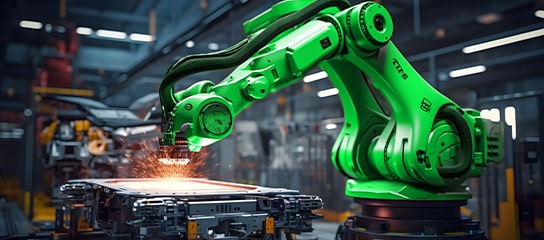
Green manufacturing is an approach that aims to minimize the impact of industries on the environment in manufacturing processes and products. Apart from introducing new product designs for energy efficiency, its main target is to opt for renewable energy sources, reduced water consumption, and better waste management as integral parts of innovative production processes.
3.1 Selecting the best HVAC systems for a green environment
Increasing the performance of HVAC systems and reducing its waste in industries is a practical method to enhance energy efficiency and assure sustainability. They can be made more efficient using purely electric heat pumps that don't generate greenhouse gases. This quality is significantly better than that of traditional gas-powered heating systems producing emissions. Installing photovoltaic cells to power HVAC systems can also help utilize renewable energy sources. It is necessary to consider factors like application requirements, energy efficiency rating, and green features that would boost its performance.
3.2 Implementing eco-friendly manufacturing principles.
Eco-friendly material options: Automotive manufacturers can reduce their carbon footprint and contribute to a more sustainable environment. This is possible by choosing materials like thermoplastics derived from natural sources like recycled plastics and polymers made from cornstarch and soybeans. They form alternatives to traditional petroleum-based materials, though their application space may be limited.
Prototyping: Prototyping and testing in additive manufacturing help designers and engineers create prototypes for error detection and design correction before production. Prototyping saves time, resources, and money, as the produced parts match the final prototype and are immediately usable.
Lean Manufacturing Principles: Adopting lean manufacturing methodologies helps streamline production processes, reduce inefficiencies, and minimize waste generation. This includes practices like Just-In-Time (JIT) inventory management and reducing excess inventory, which ultimately leads to resource conservation.
Predictive maintenance (PdM): Data analysis helps identify potential equipment defects and operational anomalies, enabling timely repairs before failures occur. Manufacturers can use PdM to be more sustainable by reducing carbon emissions, waste, and energy consumption. With the help of IoT and predictive maintenance, manufacturers can alter their production processes, reduce costs, and achieve their sustainability initiatives.
Newark has partnered with suppliers catering to various motor control and industry-related accessories such as Motors & Motor Controls,Signal Conditioning,Industrial Switches & Control Stations,Machine Safety, and Variable speed drives.
Conclusion
Various approaches, like altering motor designs, using loss-less materials in the rotor, and integrating variable speed drivers, can be combined and optimized to reduce the motor's energy consumption. It is one of the most effective ways to promote sustainability. Additionally, it also saves on operating costs. Variable-frequency drive can control speed and torque based on application demand and minimize motor energy consumption by greater extent. The importance of speed drives in sustainability is energy savings, motor reliability, and longevity. Using motors with higher efficiency adds another new aspect to using frequency converters. Implementing eco-friendly manufacturing principles like lean manufacturing methodologies and predictive maintenance by reducing carbon emissions and low energy consumption can contribute to a greener environment.