Development Kits Decoded: Bridging OEM Needs and Supplier Solutions

Discover how OEMs are accelerating innovation with turnkey development kits, SoMs, and AI enabled hardware. Get key insights from Avnet’s latest survey into shifting engineering practices and what it means for suppliers and distributors.
Engineering follows tried-and-tested processes, from proving a concept to building a prototype through early production to mass manufacturing. The development kit has emerged as perhaps the most essential tool used in new product development. 

Avnet’s development kit survey provides insights into the drivers behind the way OEMs leverage development kits and what manufacturers and distributors must do to support product development in the future.   

EXECUTIVE SUMMARY

Engineering follows tried-and-tested processes, from proving a concept to building a prototype through early production to mass manufacturing. The development kit has emerged as perhaps the most essential tool used in new product development.

Manufacturers and distributors are investing more resources into turn-key solutions enabled by software intended to accelerate development. As a result, these kits are closer to a finished product and can often be priced comparably to a custom PCB if we factor in assembly and testing. Some OEMS are even shipping development kits in place of custom PCBs and single-board computers (SBCs) in products, although our survey didn’t ask if this was in pre-production or large volumes.

Similarly, modular design continues to be adopted, leading to a parallel trend of using System-on-Modules (SoMs) and baseboards as a development platform that can be moved straight to production The driver for this shift in OEM practices seems to be the increased dependence (and development cost) of embedded software. The close integration of application-specific hardware and software provided as a development kit addresses the challenges OEMs face.

The emergence of AI-enabled processors, microcontrollers and sensors is placing greater emphasis on that integration. AI’s efficacy relies heavily on optimization at the hardware/software boundary. This dependence reverses the level of abstraction from the underlying hardware platform, which has been rising ever higher for many years. This trend is set to continue, as the integration of machine learning and AI at the edge is expected to accelerate.

All these factors are testing the status quo of product development. Engineering practices are changing as teams come under greater pressure to integrate features with more complexity into new products. Platforms like SoMs and highly integrated development kits present an opportunity and must form part of the solution. Suppliers and distributors have a responsibility to acknowledge these market pressures and react.

Avnet’s development kit survey provides insights into the drivers behind the way OEMs leverage development kits, and what manufacturers and distributors must do to support product development in the future.

APPLICATIONS DRIVE SELECTION

Development Kit Search Criteria

We all have increased access to information from social media and AI-fueled search engines through trusted sources and personal relationships. Our survey found that over 51% of engineers still rely on manufacturers for information when looking for a development kit, but over 26% of engineers prefer to go to a distributor. This indicates engineering teams value easy access to multiple manufacturers when considering a solution.

To illustrate this point, we asked what criteria engineers use when sourcing and selecting a development kit. The results below show that the application is more relevant than the primary part, and while manufacturers still rank highly, the function of the primary part is more important.

Software-graph

The preference to search by application reflects our findings that over 56% of engineers feel that finding the right development kit is their main challenge. This indicates that manufacturers and distributors could provide more assistance, while sources such as social media and trade magazine websites (both of which rank low for discovery) are less well positioned to meet this need.

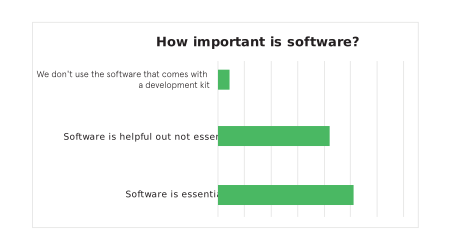
The second and third biggest challenges engineers face with respect to development kits is building the toolchain (40%) and finding software support (33%). These figures indicate the importance of software in new product development. The results of a follow-on question reinforce these findings, with 95% of respondents saying the software provided with a development kit is either helpful or essential.

ENGINEERS FAVOR LEARNING WITH DEVELOPMENT KITS

Production code

While evaluation boards can provide engineers with enough information to make design choices, development kits raise the bar. With more of a focus on specific applications, often reinforced by the inclusion of application software, development kits are one step closer to the final product.

Our survey found that around 36% of engineers purchase either a single kit or multiple kits at the start of a project, but over 39% purchase kits when they want to learn about a new device (not just at the start of a project). Those that don’t buy development kits (around 14% of respondents) normally use breadboards (32%), use simulation (25%) or go straight to PCB design (35%). The small number who go straight to PCB is the strongest indication of the relevance of development kits we received.

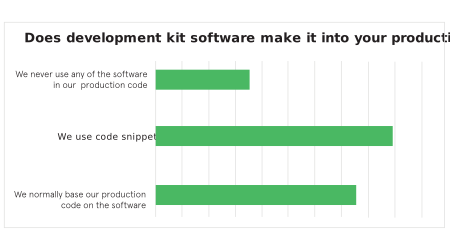
The software provided with development kits is often license-free, sometimes based on open-source projects, and increasingly application-based. When asked if they use the software provided in their production code, less than 18% of respondents said they never use any of the software provided in their products. Nearly 38% of engineers said they based their production code on the software provided, while just over 44% said they use code snippets.

SoMs

Around 55% of engineers surveyed said they modify development kits as part of their design process, and most (65%) keep those modified kits as part of the project documentation. The majority (76%) said those modified kits go on to form the basis of their production design.

Our survey also discovered that 44% of OEMs now use development kits in production. Over 62% of engineering teams are using the design files supplied with development kits (such as Gerber files, bill of materials) to design their own PCBs.

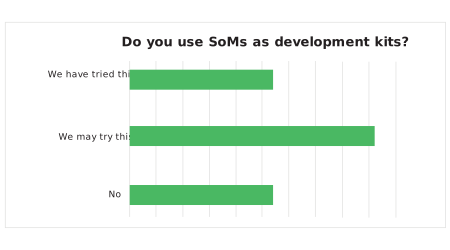
The use of modules in volume production is a growing trend, with systems-on-modules (SoMs) representing the latest development in this area. A SoM typically requires a baseboard and, together, this combination can be used as a development platform that is virtually production ready. We asked if engineers are taking this approach and found that over 73% of engineers have either tried this or are considering it.

Of those that have tried it, 89% said it helped them get to market faster, and almost all (94%) said that they would use the same approach for future projects.

SUPPLIERS SHOULD FOCUS ON SYSTEMS

Development Kit

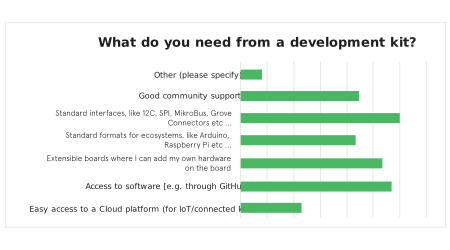
With so much focus now on software development, it is not surprising that our survey found that 90% of engineers purchase development kits that support some kind of programmable device. That tells suppliers how important it is to provide software, but we wanted to know other features engineers need from development kits. Our survey found that, while access to software scored highly (56%), it was the inclusion of standard interfaces such as I2C and SPI that they valued highest, at 60%.

We also found that over 78% of engineers feel that development kit documentation is essential, and just over 50% value documentation for the kit higher than documentation for the primary part on the kit. We feel these figures indicate suppliers and distributors have an opportunity to improve the way they support system-level design through development kits. Avnet and its associated companies, including Newark in North America and Farnell globally, can provide comprehensive design resources that take a system-level approach, with more focus on the application.

Development Kit Production

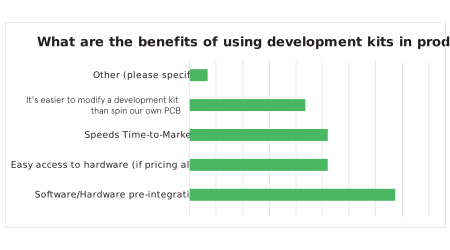
As covered earlier, over 44% of OEMs now use development kits in their production designs. Those who did were asked to provide us with further insights into why they found it beneficial. We found that hardware/software pre-integration was the biggest benefit cited (78%), with time to market and easy access to hardware in joint second place.

There are, of course, challenges with using development kits as part of their production design. Our survey found that cost was a factor, but the main reason given was that development kits are not production ready. Design optimization, through PCB design, was also important (39%), but less so than the cost and the quality of the kits.

CONCLUSIONS AND RESOURCES

Connectivity was a turning point in embedded design. Since that moment, design complexity has continued to increase. Part of that complexity is abstracted away through higher integration and module-based design. Often the cost of that hardware abstraction is greater reliance on software.

The integration of hardware and software is clearly increasing. Engineers purchasing development kits value the software provided. Engineers are actively seeking out kits that align with their application. Almost all engineers are using programmable devices, and their biggest development kit related challenges include access to software and configuring the toolchain. Avnet is working hard with supplier partners to provide system-level solutions based on development kits. Avnet’s /IOTCONNECT ™ PaaS (Platform as a Service) is application-oriented, with all software—including /IOTCONNECT core components—freely available on GitHub. Design Hub is Avnet’s free resource for reference designs, which includes Avnet’s own designs and designs from supplier partners, many of which are based on or supported by development kits.

Newark, an Avnet company, also recently launched its DevKit HQ, a new and unique online resource that brings together evaluation boards, development kits, tools and technical documents in one place. It provides a single destination to discover, compare and select application and technology solutions from leading semiconductor and hardware suppliers. The site emphasizes modular, configurable products with standard interfaces, while also offering overviews of featured development kits, datasheets, application notes, reference designs as well as additional design resources. These resources help engineers accelerate design decisions and innovation across various applications, including AI, IoT, sensors, wireless, motor control, and power management.

Aplicaciones

Internet of Things

Internet de las cosas

Artificial Intelligence

Inteligencia artificial

Industrial Automation & Control

Automatización y control industrial

Transportation

Transporte

Healthcare

Healthcare

Robotics

Robótica

Maintenance & Safety

Mantenimiento y seguridad

Alternative Energy

Alternative Energy

Further Resources

Calculators & Conversion Charts
Selection Guides and Catalogues
Essential Learning Modules
Tech Spotlights
Design Resources
Engineering Glossary
Technical Support
Parts Finder Tools