
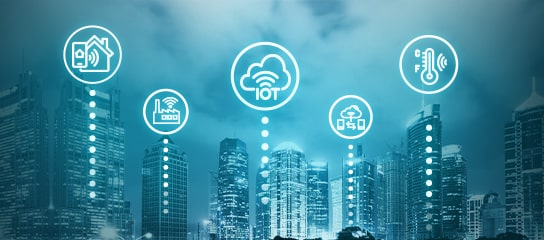
The proliferation of IoT technologies is driving this digital transformation, to better manage energy generation and distribution, and offer a wider range of services to enhance urban living, improve efficiency with sustainability. Smart city applications includes smart homes, building automation, smart meters, public lighting, parking, air quality monitoring, waste management, and smart transportation.
For instance, smart streetlights reduce energy and maintenance costs, smart parking solutions alleviate traffic by indicating available car slots, and smart waste management systems enhance efficiency by monitoring fill levels and optimizing collection routes; Low Power Wide Area Network (LPWAN) connectivity technology can interconnect these infrastructures exchanging real-time data in citywide network.
Moreover, as urban areas expand, issues like noise and air pollution intensify, smart monitoring systems gather data to safeguard citizen health and inform city planning. LPWAN technology can support to tracks environmental factors, providing insights for resource management.
Smart meters offer real-time insights into electricity usage and supply, facilitating efficient distribution and enabling dynamic tariff schemes, resulting in cost savings. Additionally, smart city infrastructure employs sensors for real-time monitoring, such as health building sensors that assess temperature, humidity, and air quality, as well as vibration sensors that detect structural changes. These technologies decrease maintenance expenses and enhance safety, contributing to more efficient, sustainable, and livable cities.
Connectivity is a key enabler for Smart City, and LPWAN technology is playing a crucial role in this regard. Among the various LPWAN options available today, Long-Range Wide Area Network (LoRaWAN) and Narrowband IoT (NB-IoT) are considered the best connectivity options for smart city and smart land solutions, providing low power and secure connections
LoRa and LoRaWAN technology
LoRaWAN is a low-power, wide-area network technology designed for IoT devices. It is commonly used in smart cities to connect and manage various IoT devices, including environmental sensors, smart parking meters, and traffic management systems.
LoRa is a patented modulation technique by Semtech that provides low-power, long-range communication using spread spectrum modulation technique derived from chirp spread spectrum (CSS) technology.
LoRa’s modulation, changes its frequency over time, this redces interference and the need to re-transmit data. Unlike FSK, LoRa’s signal is resistant to in-band interference mechanisms, require much less power, increasing battery life, allowing them to function in many places
LoRaWAN is an open standard developed by the LoRa Alliance to allow LoRa communication over long-range networks. LoRa Technology presents a suite of technical and business benefits tailored for smart city applications. It excels in delivering long-range connectivity up to 15km, simplifying deployment without the need for intricate coverage analysis, and is well-suited for both indoor and outdoor environments, operating within an efficient star network topology.
Moreover, LoRa ensures robust data transmission, thanks to its protocol that incorporates a Listen Before Talk (LBT) function, inspired by the Aloha method, and features like automatic frequency hopping and rate adaptation, which collectively guarantee reliable and efficient data exchange.
In terms of energy consumption and cost, LoRa is providing great ultra low power consumption for long-range connectivity, Sensors powered by batteries can operate up to more years, substantially reducing maintenance expenses and proving ideal for inaccessible or remote areas.
Security is not an afterthought with LoRa; it integrates advanced security protocols including end-to-end encryption and AES-128 encryption, ensuring that data transmission remains secure. The network's security framework is fortified during device registration, which facilitates mutual authentication between the end-device and the LoRaWAN network.
LoRaWAN is an open standard backed by the LoRa Alliance, guarantees smooth and straightforward scalability. Its unique star-of-stars network architecture is capable of supporting expansive networks with millions of devices.
Finally, LoRa Technology empowers cities with the flexibility to select from multiple network service providers, potentially driving down costs. Cities also have the option to establish their own municipal networks to host various applications, further optimizing expenses by leasing bandwidth to local businesses seeking to run their applications.
STMicroelectronics offers a comprehensive range of end-node solutions for LoRa applications, including sensors, processors, and RF communication solutions. The STM32WL is the world's first wireless microcontroller to integrate a LoRa transceiver on its silicon die, providing a more integrated solution than previous industry offerings. STMicroelectronics offers several evaluation boards based on the STM32WL, including the STEVAL-ASTRA1B, which is a multi-connectivity solution that includes LoRa, Bluetooth, and NFC, as well as GNSS positioning and several MEMS sensors such as temperature, pressure, accelerometer, and gyroscope. This solution is an end-to-end proof of concept, with the STAssetTracking Mobile app for configuration and real-time monitoring via BLE and a web-based cloud dashboard, the DSH-ASSETRACKING, for remote real-time monitoring
Moreover, STMicroelectronics offers an intriguing solution for LoRa connectivity with the STDES-CBMLoRaBLE reference design. This design is ideal for infrastructure monitoring, featuring Bluetooth and sub-GHz devices for connectivity. With a vibrometer and inclinometer on board and dedicated algorithms for vibration analysis and tilt monitoring, it's possible to monitor assets and infrastructure using long-distance connectivity for predictive maintenance applications. Additionally, ST provides a software solution that uses AWS, the DSH-PREDMNT, to help provision the device, log data, visualize information, and perform cloud asset monitoring anytime and anywhere.
NBIoT technology
Recently, another interesting LPWAN technology has emerged, NB-IoT (Narrow Band Internet of Things), provides long-range and low power connectivity, It operates over existing mobile networks, LTE band, which allows it to leverage existing mobile networks, using existing infrastructure to guarantee its widespread adoption and effectiveness.
One of the technical strengths of NB-IoT is its use of Orthogonal Frequency Division Multiplexing (OFDM) with modulation schemes like QPSK (Quadrature Phase Shift Keying) or BPSK (Binary Phase Shift Keying). These multi-carrier options are highly robust against interference, which is a common challenge in wireless communication. The result is a reliable and efficient way to transmit data over long distances without the need for high power consumption. NB-IoT's native support for IPv6 ensures that it can handle the huge number of devices that are expected to be part of the IoT ecosystem. With IPv6, each device can have its unique address, facilitating seamless communication across the network.
Security in IoT is a must, and NB-IoT addresses this concern by utilizing encryption and authentication mechanisms that are on par with those used in mobile phones. With 256-bit encryption as standardized by the 3GPP, NB-IoT ensures that data transmitted across its network maintains integrity and confidentiality.
The Global System for Mobile Communications Association (GSMA) Infrastructure plays a pivotal role in the success of NB-IoT. It offers worldwide coverage, ensuring communication reliability and the ability to support a large number of devices. This standardized technology is crucial for interoperability, allowing devices from different manufacturers and service providers to work together seamlessly.
Perhaps one of the most compelling advantages of NB-IoT is the low cost of deployment. Since it operates within the 4G/5G GSMA cellular infrastructure, there is no need for additional hardware or infrastructure investment. This aspect is particularly attractive for businesses and municipalities looking to implement IoT solutions without incurring significant expenses.
STMicroelectronics is providing interesting NBIoT solution based on module approach.
The ST87M01 is a turn-key, ultra-compact, LTE Cat NB2 NB-IoT and GNSS module that offers global multi-frequency band coverage and is certified under 3GPP Release 15; it boasts secure Firmware Over-The-Air (d-FOTA) updates, advanced security features, and customized AT commands, ensuring a 100% ST product with Bill of Materials (BoM) and supply chain independency, alongside a product longevity of over 15 years.
Conclusion
LoRaWAB and NBIoT technology are the most promising communication technologies for Smart cities applications scenario, and ST offers the right technologies, such as products and solutions, to help professionals accelerate proof of concept and field-testing phases.
That are designed to facilitate the development and deployment of both LoRa and NB-IoT applications. Moreover, ST's commitment to fostering a 'ready-to-go' ecosystem is evident in its collaboration with partners, ensuring that customers not only have access to the hardware but also to software, tools, and community support necessary to bring their smart city solutions to life swiftly and efficiently. Click here to view products




Tecnologías







Inteligencia artificial
¡Una de las más grandes revoluciones en la historia de la humanidad! La inteligencia artificial es un concepto integral que incorpora la inteligencia humana a las máquinas
DEVKIT HQ
The #1 Destination for Embedded Evaluation Boards, Development Kits, and Tools
IoT Sensor to Cloud Platform
/IOTCONNECT™ accelerate your loT journey with secure, ready-to-use cloud connectivity
Further Resources
Calculators & Conversion Charts
Selection Guides and Catalogues
Essential Learning Modules
Tech Spotlights
Design Resources
Engineering Glossary
Technical Support
Parts Finder Tools
Recursos técnicos
Explore nuestra biblioteca cuidadosamente seleccionada de documentos técnicos, artículos técnicos, videos, módulos de capacitación, tutoriales y mucho más para ayudarle a desarrollar sus diseños, su negocio y su profesión.

La más grande comunidad online de ingenieros
CONÉCTESE | APRENDA | CREE | INSPIRE